
Is IPTV Legal in Australia? 2026 Guide

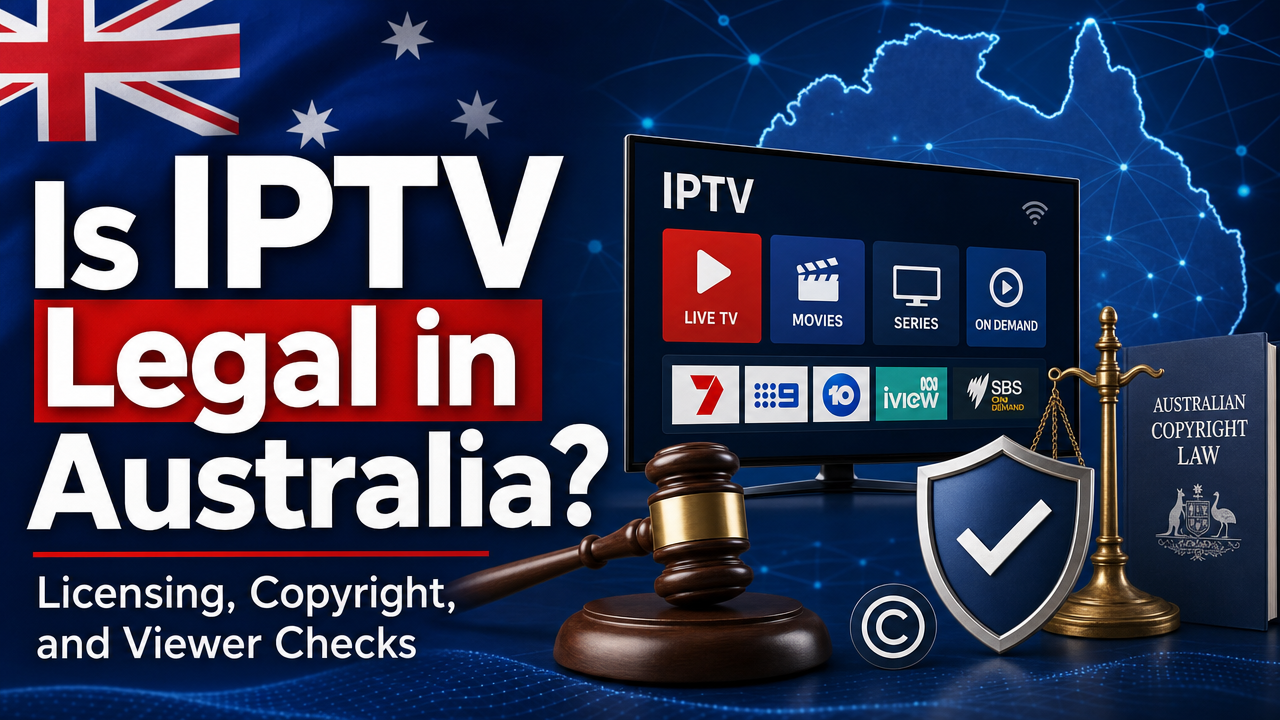
Streaming TV over the internet sounds simple, but the legal side trips up a lot of Aussies. So, is IPTV legal in Australia? The short answer is yes — but only when the service is properly licensed and the content is distributed with permission. The grey market services flooding Facebook groups and Telegram channels are a different story altogether.
This guide breaks down Australian copyright basics, how licensing actually works for Internet Protocol Television (IPTV), what viewers should check before paying, and the warning signs of a dodgy provider. You’ll finish with a clear checklist you can use today.
Is IPTV Legal in Australia? The Straight Answer
IPTV — short for Internet Protocol Television — is the technology that delivers live TV and on-demand video through your internet connection instead of a satellite dish or antenna. The technology itself is 100% legal in Australia.
Foxtel Now, Kayo, Stan, Binge, and Netflix all use IPTV technology under the hood. They hold proper broadcast and streaming licences for every show, sport, and movie on their platforms.
The legal question isn’t about the technology. It’s about whether the specific service you’re paying for has the right to distribute the content it streams to you. That’s where most cheap, no-name IPTV apps fall over.
Legal vs Illegal IPTV — The Key Difference
- Legal IPTV: The provider holds licensing agreements with broadcasters, sports leagues, and movie studios. They pay rights fees and operate as a registered business.
- Illegal IPTV: The provider restreams content without permission — usually thousands of premium channels for A$10 a month. No licensing, no rights, no accountability.
If a deal looks too good to be true, it almost always is. A service offering every Premier League match, every UFC pay-per-view, and the full Foxtel sports package for the price of a coffee is not paying rights holders.
Australian Copyright Law and Streaming
The Copyright Act 1968 protects broadcasters and content creators in Australia. The law has been updated several times to handle online piracy, with the most significant changes coming through the Copyright Amendment (Online Infringement) Act 2015 and 2018 updates.
These laws give rights holders the power to apply to the Federal Court for site-blocking orders. That’s why you’ll see Australian internet service providers blocking certain piracy sites and IPTV portals — they’re following court orders.
What the Law Says About Viewers
Here’s the part most people get wrong. In Australia, the heavy legal action is usually aimed at operators and resellers of pirated streams — not individual viewers watching at home.
That said, viewing pirated content can still breach copyright law. You’re consuming an unauthorised reproduction of a protected work. Penalties for individuals are rare in practice, but the legal risk is not zero.
More common consequences for viewers include:
- Sudden service shutdowns with no refund (you lose your money)
- Credit card data leaks from dodgy payment portals
- Malware bundled with unofficial apps and APK files
- ISP throttling or warning letters
- Compromised devices joining botnets
How IPTV Licensing Actually Works
Licensing is the contract between a content owner (a sports league, studio, or broadcaster) and a distributor (the IPTV service). It spells out which content can be shown, in which countries, on which devices, and for how long.
A legitimate IPTV provider in Australia needs to clear rights for each piece of content it offers. That can mean separate deals for live sports, international news, kids’ shows, and on-demand movies.
Why Licensed Services Cost More
Sports rights are eye-watering. Foxtel reportedly pays hundreds of millions per year for AFL and NRL rights alone. That cost gets passed to subscribers.
This is why a pirated service can sell you “everything” for A$10 — they pay nothing for rights. They simply restream channels stolen from legitimate broadcasters in other countries.
The Grey Area: International Channels
Some IPTV providers operate in a grey zone. They may hold rights in one region and stream globally without clearing Australian rights specifically. This is technically a breach, even though the service appears polished.
Always check that the provider you’re considering has clear, traceable business operations and a transparent content catalogue. For a deeper look at how the tech itself works, our guide on what IPTV is in Australia covers the basics in plain English.
Viewer Checks: How to Assess a Provider Before Paying
Before you hand over your credit card details, run through this checklist. It takes 10 minutes and could save you hundreds of dollars and a major headache.
1. Check the Business Details
A legitimate provider will list a business name, contact details, and a clear refund policy. If the only contact method is a Telegram handle or an anonymous email, walk away.
Look for:
- A registered business address
- Working customer support (try the contact page before subscribing)
- Clear terms of service
- Refund or money-back guarantee in writing
2. Test Before You Commit
Any decent provider will offer a free trial. This lets you check stream quality, channel reliability, and the electronic programme guide (EPG) before paying.
If you want to see how this works in practice, you can grab a free IPTV trial and stream-test the service on your own internet plan. No commitment, no card details upfront.
3. Look at the Channel Lineup
Browse the full channel list. A transparent provider will publish exactly what’s available on their channels page so you know what you’re getting.
If a service hides its lineup behind a paywall or only shows a “sample,” that’s a red flag. You should know what you’re buying.
4. Read Independent Reviews
Search the provider name on Reddit, Whirlpool forums, and Trustpilot. Look for patterns — not just five-star reviews, which can be faked.
Focus on:
- How long the service has operated
- Refund stories (both good and bad)
- Uptime during major sporting events
- Customer support response times
5. Check Payment Methods
Reputable services accept standard payments — credit card, PayPal, or established gateways. If a provider only accepts crypto, gift cards, or bank transfers to a personal account, that’s a warning.
Those payment methods exist for a reason: they can’t be reversed. If the service disappears next week, your money is gone.
6. Verify Uptime Claims
Quality matters. A reliable IPTV service should advertise — and deliver — 99% uptime or better. Ask about their server network and stream backup options.
Premium providers like Sydney IPTV publish uptime figures (99.9%), subscriber numbers (87,000+), and a transparent catalogue (28,000+ channels and 90,000+ VOD titles) so you can verify what you’re buying.
Common Red Flags That Scream “Walk Away”
Spot these signs early and save yourself the trouble:
- Lifetime subscriptions for A$50: No legitimate business can operate on this model. They’ll vanish in months.
- “All sports + all PPV included”: Pay-per-view (PPV) events like UFC and boxing cost the rights-holders millions. No A$10 service has those rights.
- APK files via random links: Unofficial Android Package Kit (APK) files often contain malware. Stick to apps from official sources.
- No EPG or broken guide: A missing or constantly wrong electronic programme guide signals a hastily built service.
- Pressure tactics: “Only 5 spots left!” or “Price doubles tomorrow!” are scammy sales tactics.
- Resellers without verification: If someone is reselling another provider, you have no direct support line when things break.
VPNs, IPTV, and Australian Law
Virtual Private Networks (VPNs) are completely legal in Australia. Plenty of Aussies use them for privacy, security on public Wi-Fi, and to access overseas Netflix libraries.
However, using a VPN to access pirated content doesn’t change the legal status of that content. A VPN protects your privacy — it doesn’t grant you a licence.
Legitimate IPTV services in Australia don’t require you to use a VPN. If a provider tells you that you “must” use a VPN to watch their streams, that’s usually because the streams aren’t licensed for your region.
Devices, Apps, and the Legal Picture
The device you use is rarely the issue. Smart TVs, Android boxes, Amazon Fire Sticks, iPhones, and laptops can all run IPTV apps.
Issues arise when devices come pre-loaded with piracy apps. “Fully loaded” Kodi boxes or Fire Sticks sold at markets often include addons that stream unlicensed content. Selling these devices is illegal in Australia under the Copyright Act.
Safe App Sources
Stick to official app stores where possible:
- Google Play Store for Android and Google TV
- Apple App Store for iPhone, iPad, and Apple TV
- Amazon Appstore for Fire TV devices
- Samsung and LG official TV app stores
Apps like IPTV Smarters Player on the App Store are legitimate playback tools — they’re neutral software. What you load into them determines legality.
What About Streaming Sports Specifically?
Sport is the number one reason Aussies look at IPTV. Foxtel and Kayo hold most premium sports rights, but their pricing pushes people to look elsewhere.
Legitimate options for sports include:
- Kayo Sports (AFL, NRL, cricket, motorsport)
- Stan Sport (rugby union, UFC, Roland-Garros)
- Foxtel iQ or Foxtel Now
- Free-to-air via 7plus, 9Now, and 10 Play (limited matches)
- Licensed IPTV providers with sports-package agreements
If a service offers every channel from every country for one low price, the maths simply doesn’t add up. Real sports rights cost real money.
Choosing a Reliable, Properly Run IPTV Service
Reliability and legitimacy go hand in hand. Services that pay for content and infrastructure can afford robust servers, real support staff, and consistent uptime.
When comparing options, weigh up:
- Catalogue size and quality (channels plus video-on-demand)
- Stream resolution (HD, Full HD, 4K where available)
- Multi-device support (how many screens at once)
- Customer support hours and response time
- Transparent pricing — look at the subscription plans page to compare costs against features
- Refund policy and trial availability
At sensible price points starting around A$7.50/month, you can get serious value without resorting to dodgy resellers. The trick is doing your homework first.
Frequently Asked Questions
Can you go to jail for using IPTV in Australia?
Individual viewers in Australia have not been jailed for watching pirated streams. Legal action focuses on operators and large-scale resellers. However, copyright infringement penalties for serious cases can include fines up to A$117,000 for individuals and prison terms for commercial-scale piracy.
How do I know if an IPTV service is licensed?
Check for a registered business, transparent pricing, contactable support, and a published channel list. Licensed services don’t hide their identity. If you can’t find a business name, address, or working support line, assume it isn’t licensed. Browse the provider’s FAQ page for clear policies and ownership details.
Is it legal to watch IPTV using a VPN in Australia?
Using a VPN is legal. But a VPN doesn’t make pirated content legal — it only hides your activity. If you’re using a properly licensed IPTV service, you don’t need a VPN. Need it only for privacy, not to bypass content restrictions.
Will my internet provider know I’m using IPTV?
Your internet service provider (ISP) can see that you’re streaming data, but they don’t typically inspect the content of legitimate streams. ISPs do enforce Federal Court site-blocking orders, which is why some piracy domains stop working without warning.
What’s the safest way to try IPTV in Australia?
Start with a free trial from a verifiable provider. Test stream quality, check the channel list against what was advertised, and confirm support actually responds. Pay with a credit card or PayPal for buyer protection. Only commit to a longer plan once you’re satisfied.
Final Thoughts
So, is IPTV legal in Australia? Yes — when you choose a properly licensed, transparent service that pays for the content it streams. The technology is fine; the dodgy operators are the problem.
Do your viewer checks, test before paying, and stick to providers with a real business, real support, and real reviews. You’ll get reliable streams without the legal grey area or the disappearing-act risk.
Ready to try a transparent, reliable service? Grab a free IPTV trial today or message the team through the contact page to ask any question before you subscribe.
You might also like
Free vs Paid IPTV in Australia: What’s the Difference?
If you’re weighing free vs paid IPTV in Australia, the most important thing to understand first is that “free IPTV” means two…
Read article →
15 Best War Movies to Watch in Australia
War movies have always connected strongly with Australian audiences. They are not only about explosions, uniforms and battlefield spectacle. The best war…
Read article →
20 Best Sports Movies to Watch
Sports movies work because they turn competition into drama. A good sports film is never just about the scoreboard. It is about…
Read article →