
IPTV Providers Australia: Service Types, Legal Options and Red Flags
 Declan Mowbray
📅 June 20, 2026
⏱ 8 min read
Declan Mowbray
📅 June 20, 2026
⏱ 8 min read
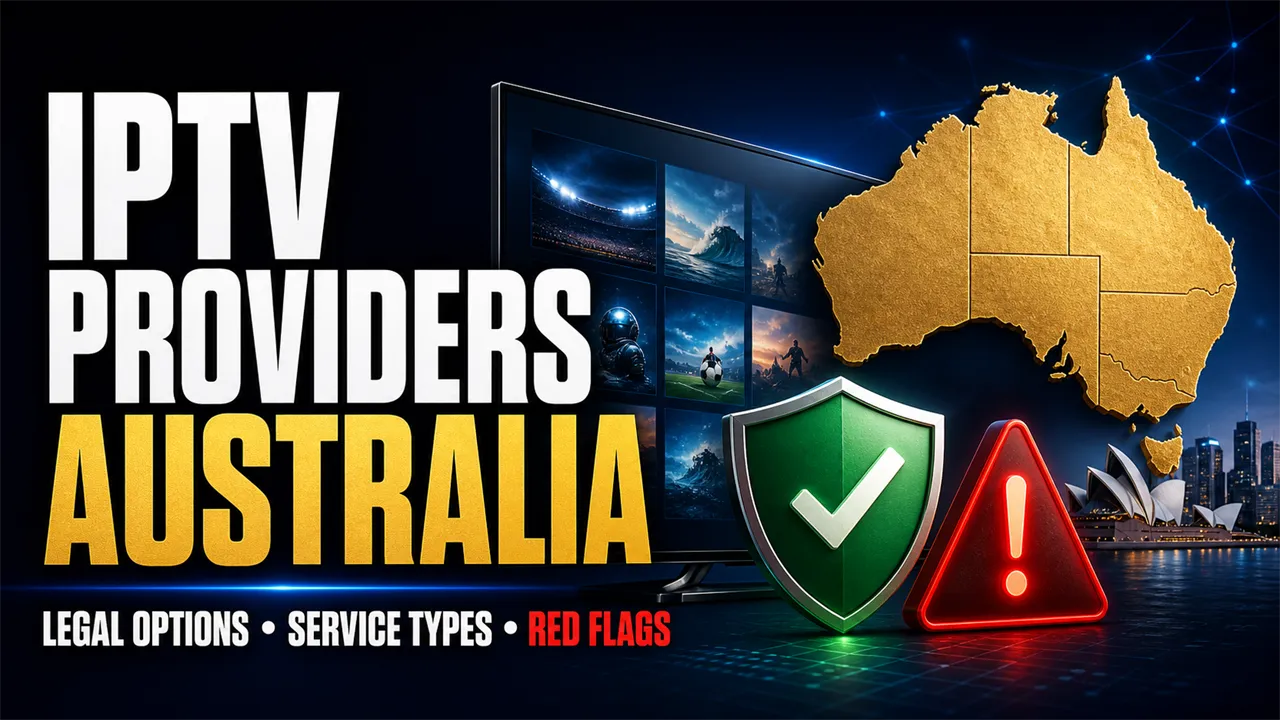
Choosing among IPTV providers in Australia can feel confusing, partly because the term covers very different kinds of services — from large licensed platforms to smaller independent subscriptions. This guide is a neutral, educational look at how IPTV providers differ, how content rights affect legality, and the practical security and payment checks any careful viewer can make. The aim isn’t to praise or criticise any part of the industry, but to help you ask good questions and make an informed, confident decision.
In short: An IPTV provider is any service that delivers live TV and on-demand content over the internet. The most useful way to compare them is by service type, content licensing, and how transparently they handle payment, privacy, and support — not by channel count alone.
This article is general information for Australian consumers and is not legal advice. For legal questions, consult a qualified professional or the official sources linked below.
What Is an IPTV Provider?
An IPTV provider is a service that delivers television — live channels, catch-up, and video-on-demand — over an internet connection instead of a cable, satellite, or antenna signal. “IPTV” stands for Internet Protocol Television, and the technology itself is simply a modern way of transmitting video.
Providers vary widely. Some are large, well-known platforms operated by established media companies. Others are independent subscription services run by smaller teams. Both can be legitimate, and both can differ in content, reliability, pricing, and how openly they operate. Understanding those differences is the first step to choosing well. For a plain-language primer, see our explainer on what IPTV is and how it works in Australia.
Licensed Platforms vs Independent Subscription Services
The clearest way to group IPTV providers is by how they obtain and license content. Neither category is automatically “good” or “bad” — what matters is transparency and whether a service holds the rights to what it streams.
| Aspect | Licensed / official platforms | Independent subscription services |
|---|---|---|
| Content rights | Hold formal distribution agreements with rights holders | Varies — worth verifying directly with the provider |
| Typical content | Defined channel/app catalogue | Often broad, multi-region line-ups |
| Transparency | Established company details, public terms | Ranges from very transparent to limited information |
| What to verify | Plan terms and pricing | Licensing, company details, and the checks below |
The takeaway is not that one type is legitimate and the other isn’t. It’s that an independent service deserves the same scrutiny you’d give any online purchase — and a transparent provider will happily answer questions about how it operates.
App-Only IPTV vs IPTV With a Box
Providers also differ in how you watch: through an app on a device you already own, or through a dedicated streaming box. Both are common in Australia, and the right choice depends on your setup.
| Aspect | App-only IPTV | IPTV with a box |
|---|---|---|
| What it is | An app you install on a Firestick, smart TV, phone, or computer | A physical streaming box, sometimes sold with a subscription bundled |
| Setup | Install the app, enter your login | Plug into HDMI, connect to Wi-Fi or Ethernet |
| Cost | Subscription only | Subscription plus hardware cost |
| Flexibility | Watch across devices you already have | Tied to the supplied box |
| Best for | Most households with a recent smart TV or streaming stick | Viewers who want a ready-to-go, single-device setup |
| Watch-outs | Use the official app where possible (see below) | Confirm what happens to the box if the subscription ends |
If you’re weighing devices specifically, our roundup on the best IPTV Australia services and how to choose one covers device compatibility in more depth.
Is IPTV Legal in Australia?
IPTV technology is legal in Australia — it is simply a method of delivering video over the internet. Whether a particular service operates lawfully depends on the content rights behind it. Three questions help clarify the picture.
Is IPTV technology legal? Yes. The protocol that streams video over the internet is the same technology used by mainstream apps and broadcasters. Using IPTV is not, in itself, unlawful.
Does the provider have distribution rights? This is the key factor. A service that holds agreements with the owners of the channels and content it offers is distributing that content with permission. Where a service streams content without the necessary rights, that raises copyright questions under Australian law — specifically the Copyright Act 1968 (Cth). Rights holders and regulators such as the Australian Communications and Media Authority (ACMA) handle enforcement in this area.
Is the application itself legitimate? Favour apps available through official channels — the Google Play Store, Apple App Store, Amazon Appstore, or a provider’s own official website — and check the developer details, reviews, and requested permissions. An app’s distribution method is a useful signal of how transparently a provider operates.
For a fuller, Australia-specific breakdown, read our dedicated guide on whether IPTV is legal in Australia. The practical message for consumers is simple: choosing services that are open about their licensing and company details is the safer, lower-stress path.
What Security and Payment Risks Should You Check?
Beyond legality, everyday online-safety checks apply to any IPTV subscription, just as they would to any internet purchase. Run through this list before you enter payment details:
- HTTPS and secure checkout. The site should use HTTPS and a proper checkout. Important caveat: HTTPS only means the connection is encrypted — it does not prove the provider is trustworthy. Treat it as a baseline, not a guarantee.
- Recognisable payment processor. Familiar processors (major card networks, well-known gateways) add a layer of buyer protection and dispute resolution.
- Privacy policy. A clear policy explaining what data is collected and how it’s used signals an organised, accountable service.
- Automatic-renewal disclosure. The provider should state plainly whether the plan renews automatically, and when.
- Clear cancellation procedure. You should be able to find how to cancel before you subscribe, not after.
- Refund conditions. Look for stated refund terms or a money-back window.
- APK download source. If installing an app file (APK) directly, get it from the official app store or the provider’s official site — not an unknown third-party host.
- App permissions. Review what the app asks to access. A media player rarely needs contacts, messages, or device-admin rights.
- Account-password practices. Use a unique password, and be cautious of services that email your password in plain text.
- Whether cryptocurrency is the only payment method. Crypto can be legitimate, but a service that accepts only crypto removes the chargeback protection a card offers — worth noting before you commit.
None of these checks, on their own, condemns a provider. Together, they paint a reliable picture of how professionally a service is run.
What Are the Red Flags of an Unreliable IPTV Provider?
Some signals are stronger than others. The following are worth treating as clear warning signs — not because the whole industry behaves this way, but because reputable services generally avoid them:
- No terms, privacy, or refund policy published anywhere on the site.
- Crypto-only payments with no card or recognised-processor option.
- Fake countdown timers or “only 2 left” urgency on a digital subscription.
- Copied or unverifiable reviews that can’t be traced to a real source.
- Guaranteed “zero buffering.” No honest service can promise this — streaming quality depends on networks and servers, so a realistic provider talks about being designed to reduce buffering, not eliminating it.
- Unknown APKs requesting unnecessary permissions.
- Requests for remote access to your device to “set things up.”
- No explanation of connections, renewals, or cancellation.
- Pressure to buy a multi-year plan immediately, especially “lifetime” deals.
If you spot several of these together, it’s reasonable to step back and look for a more transparent option.
Questions to Ask Before Subscribing
Use this reusable checklist with any IPTV provider. Save it, and run through it each time — a confident, legitimate service will have ready answers to all ten:
- Who operates the service? Is there a real company name and contactable team?
- What channels and countries are included? Does it actually cover what you want to watch?
- Which devices are supported? Firestick, smart TV, phone, box?
- Is an external player required? Or does it work within its own app?
- What internet speed is recommended? Does it match your NBN plan?
- Does the subscription renew automatically? And can you turn that off?
- How do cancellations and refunds work? Is the process clear and stated upfront?
- Is a trial available without a long commitment? A short, low-risk test is ideal.
- What customer information is collected? And is there a privacy policy?
- How can support be contacted? Is there a responsive, real channel?
A service that answers these openly — and lets you test before committing — is showing exactly the transparency you want. If you’d like to apply this checklist to a clearly documented Australian service, you can try a free 24-hour Sydney IPTV trial with no long-term commitment.
Frequently Asked Questions
Is using IPTV legal in Australia?
IPTV technology is legal in Australia. Whether a specific service is lawful depends on whether it holds the rights to distribute its content, under the Copyright Act 1968. Choosing providers that are transparent about licensing and company details is the safer path.
How can I tell if an IPTV provider is legitimate?
Look for clear company details, published terms, a privacy policy, a recognisable payment processor, and a free trial or refund window. Legitimate providers explain how renewals, cancellations, and support work before you pay.
Is it safe to pay for an IPTV subscription online?
It can be, if you take normal precautions: use a secure checkout and a recognised payment method, avoid services that demand crypto-only payment, and read the refund and cancellation terms first. HTTPS alone does not prove a provider is trustworthy.
Do I need an IPTV box, or just an app?
Most Australian households can use an app on a device they already own, such as a Firestick or smart TV. An IPTV box is a convenient all-in-one option, but check what happens to the hardware if the subscription ends.
Conclusion: Choose with Confidence, Not Pressure
The healthiest way to compare IPTV providers in Australia is calmly and methodically: understand the service types, check that a provider is open about content rights, and run the security, payment, and “questions to ask” checks above. Most of this is simply good online-buying practice. Approached that way, you can enjoy the flexibility IPTV offers while avoiding the small number of services that cut corners.
If you want a transparent place to start — with clear plans, published terms, and a no-pressure trial — you can explore Sydney IPTV’s subscription options or test the service first with a free 24-hour trial.
Related Articles
You might also like
How Does IPTV Work? IPTV Streaming Explained for Australia
How does IPTV work? In one line: IPTV works by converting television and video into compressed digital data, delivering it across the…
Read article →